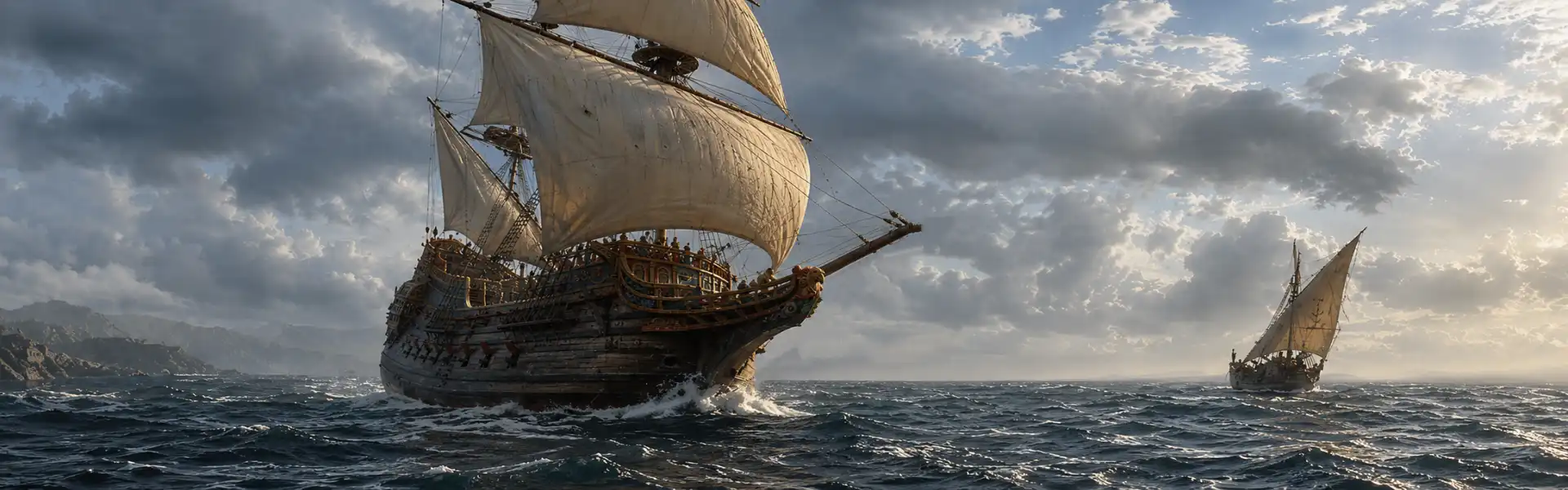
Box Hauling in Naval Historical Fiction: A Dangerous Sailing Maneuver

A Ship at the Edge of Its Choices
One challenge that I consistently experienced in writing the naval world of Sic Parvis Magna was balancing the historical research with the reader’s experience the story. What I liked in great nautical historical fiction from C.S. Forester, Patrick O’Brian and many others is that danger comes not only from the enemy astern, but from whether the ship—and crew—will answer in time.
Somehow, Horatio Hornblower or Jack Aubrey just knew the perfect thing to do.
In one scene from my Francis Drake world, captain Trelawney faces that kind of problem. As a faster hostile caravel gives chase, escape is not possible. After assessing the enemy’s positioning, Trelawney decides to execute a box hauling maneuver in the open water of the Bay of Biscay.
The Cinematic Spark: Pirates of the Caribbean, Club Hauling, and Desperate Seamanship
Part of the inspiration came from the famous anchor maneuver in Pirates of the Caribbean, The Curse of the Black Pearl, where Elizabeth Swann suggests dropping the Interceptor’s starboard anchor to swing the vessel around and fight.
Captain Barbossa: “They are club hauling! Hard a port! Rack the starboard oars!”
It works because seamanship becomes visible drama: the anchor falls, the ship answers, and the enemy receives their due. Elizabeth’s audacity brings the Interceptor alongside the Black Pearl for an exciting broadside engagement.
However, the world of Francis Drake is set some 150-200 years before the world of the Pirates of the Caribbean. And the open water of the Bay of Biscay is substantially deeper than the shoals that the Interceptor was over. I needed to work out if a similar maneuver, executed by a vessel designed to primarily sail the trade winds, was even possible for my historical fiction novel.
In my case, I also needed to depend on a bit of creative license.
What Is Box Hauling?
Box hauling is different from club hauling. Rather than using an external anchor, it depends on the strength of sails, sturdiness of standing and running rigging, the ship’s own loss or gain of way, and a lot of nerve.
Box hauling is a way of turning a square-rigged vessel by backing the head sails. Later seamanship manuals are valuable because they explain the mechanics. Commodore Luce’s Textbook of Seamanship, for example, shows how a square-rigged vessel can be brought around through such a maneuver.
But Luce was not writing for Drake’s world. His ships, assumptions, and training systems, and naval terminology belong to a later age. The value of Luce’s writing is explanatory, he helps me understand what canvas can do.
During Drake’s time, the materials of ship design were both similar and different. The danger of the maneuver comes from the inherent design of the ship—the standing rigging supports the masts against wind pressure from behind the ship. Coming into irons (which is dead into the wind) and backing the sails reverses that force, forcing the ship to stop, then fall off.
When the ship loses way, the yards, braces, and sails must help turn the vessel because the rudder will not work until water is moving across it again. This is a significant strain on the standing rigging.
Why Trelawney Would Risk It
For Trelawney, the maneuver is not nautical bravado. He is making a dangerous calculation under pressure. A fleeing ship normally wants to preserve speed.
That means a box-hauling-like maneuver only makes sense if the alternative is worse. It also makes sense if Trelawney understands the vessel as a living system of wood, rope, canvas, wind, and men that depend on his decisions. He must make the right choice and give the order before hesitation turns danger into disaster.
If the timing (and the rigging) holds, the Tiger escapes not by speed alone, but by making an unexpected turn and counterattacking before the enemy can adjust.
- Trelawney accepts the danger of losing speed because he understands that he must do something unexpected.
- He orders the Tiger to turning up and into the course of the caravel, forcing it to adjust course to avoid a collision.
- As the sails backfill, ship pauses before gaining sternway. Trelawney uses the loss of momentum to allow the Tiger’s broadside to find her opponent before the wind pushes her through the rest of the turn.
And, the young Drake learns an important lesson.
Could a Sixteenth-Century Galleon Do This?
This is where the research (and theory) needs honesty. The term box hauling does not start to appear in the English seamanship vocabulary in the earlier part of eighteenth century.
However, this is where a little creative license comes in. The physical logic is older than its later textbook references.
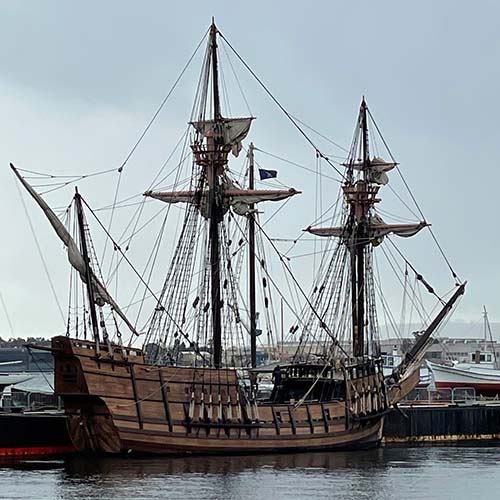
A sixteenth century-style galleon possessed the necessary ingredients: square sails, yards that could be braced, a rudder, and a crew trained to work the ship. The early modern European ships evolved past the single-masted round ships, but the masts were still generally shorter than what seen in the later age of sail ships. Finally, well-made hemp rope—wormed, parceled, and served—could carry tremendous loads, even if it was not the steel wire of a later age.
I think that a galleon could plausibly attempt a maneuver resembling box hauling, and that a skilled mariner might attempt it to escape a worse fate.
Read Next
Sources & Further Reading
Did You Like This?