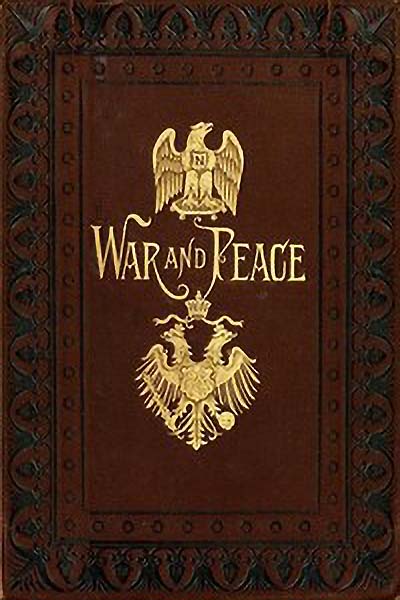
Best Historical Fiction Books: War and Peace by Leo Tolstoy
Above him there was nothing but the sky—the lofty sky.
Prince Andrei Bolkonsky lies wounded on the field at Austerlitz, looking up. The French are winning. Men are running and shouting and dying around him. The flag of his battalion is also on the ground. A few moments ago he had imagined himself a hero, about to turn the battle; now he is flat on his back and cannot move, and the rest of Austerlitz has gone strangely quiet. What remains is the sky, and the odd shock of realizing he had never really looked at it before. The passage is one of the most celebrated in world literature, and it carries, in a few sentences, something of what Tolstoy was doing throughout War and Peace. The novel sets its people against enormous forces—battles, politics, history itself—and then asks what actually matters.
Written between 1863 and 1869 and serialized in The Russian Messenger from 1865, War and Peace follows five aristocratic families through the Napoleonic Wars, from the opening salon chatter of 1805 to the ragged aftermath of Napoleon’s 1812 invasion of Russia, but also covers history, theology, freemasonry, estate management, military command, and the psychology of love. Its cast runs to several hundred. Despite its 1,400 pages, it is one of the most readable books ever written. Tolstoy himself had trouble describing what he had made. In a note written after publication, he insisted the book was not a novel, not a poem, not even a historical chronicle. It was simply, he said, what he had wanted and been able to express.
Not a Novel, Not a Poem
War and Peace is a historical fiction novel in the sense that it follows invented families through invented crises that occurred before Tolstoy’s time. But it is also a work of historical revisionism in the guise of fiction. Napoleon, Alexander I, Kutuzov, Bagration, Speransky, Rostopchin — these are real historical figures, drawn from memoirs and archives and then judged with considerable interpretive freedom. Long stretches of the book abandon narrative altogether for extended philosophical discourse. The Second Epilogue, which most readers skip, is a standalone essay on historical causation.
As a result, The book feels larger than the sum of its plots. Tolstoy was writing in the 1860s about events half a century in the past. He worked from archives, regimental histories, published memoirs, and the oral accounts of older relatives—several of his family had been in or near the events of 1812. The result is not historical fiction in the conventional sense. It is closer to an argument with history itself. Tolstoy distrusted the standard nineteenth-century treatise of “Great Men” who moved armies and decided fates. War and Peace is, in part, his book-length refusal of that theory.
Five Families in the Shadow of Napoleon
The reader who arrives at War and Peace expecting battles alone is surprised. Much of the book is set in drawing rooms, on sleigh rides, hunting in the autumn, sitting with dying parents, or dancing at balls. The human center of the book is a constellation of five families—the Rostovs, the Bolkonskys, the Bezukhovs, the Kuragins, and the Drubetskoys — whose fortunes cross and recross over fifteen years.
Three characters carry most of the book’s inner life.
Pierre Bezukhov—fat, awkward, illegitimate, then suddenly the heir to an enormous fortune—stumbles through freemasonry, a disastrous marriage to the beautiful Hélène, a half-formed plot to assassinate Napoleon, captivity, and something close to peace.
Prince Andrei, cold, intellectual and disillusioned, keeps reaching for something—glory, love, meaning—and keeps failing.
Natasha Rostova, first introduced as a thirteen-year-old bursting into a grown-up dinner party, grows across the novel’s span from a prodigy of childish vitality into a woman who has survived a near-elopement, a broken engagement, and the deaths of almost everyone she loves. These three, with the quieter presences of Nikolai Rostov and Princess Marya, are at the center of the book.
Some of the most admired scenes in Russian literature come from this book. Natasha’s first ball. The wolf hunt at the Rostovs’ estate at Otradnoye, where she rides hard through autumn woods and the novel briefly becomes a kind of ecstatic prose poem. The night at her uncle’s lodge where she dances an impromptu Russian folk dance to a balalaika, astonishing everyone by knowing steps her French education could not have taught her. These scenes do not pause the historical novel—they are Tolstoy’s commentary on history.
Tolstoy’s Theory of History
The philosophical essays exist, and are the feature most responsible for the book’s distinctive “strangeness.” Tolstoy’s argument, delivered in recurring digressions and then in the Second Epilogue, is that history is not made by generals and emperors. It is made by the infinite sum of individual actions, each one too small to see. Napoleon did not cause the invasion of Russia; the invasion was caused by millions of Frenchmen and Russians acting under pressures they did not fully understand. “Great Man” history is a flattering fiction.
This is why Tolstoy’s Napoleon appears so unsettling on the page. He is small. He postures, he flatters himself; he mistakes his own self-importance for causal power. At Borodino, he issues orders that are ignored or overtaken by events before they arrive. He believes he is controlling the battle as he watches it, though he doesn’t.
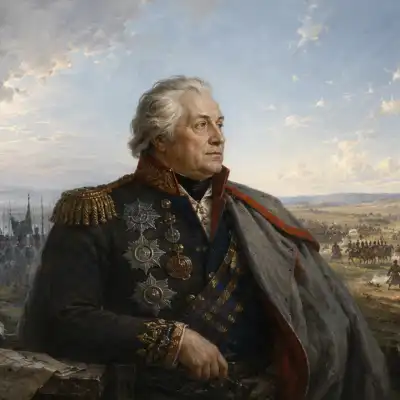
Kutuzov, the aged Russian commander-in-chief, appears as a kind of hero because he does not believe in the power of a commander to direct a battle. He dozes at councils. He lets events run. He trusts the army and the ground. He wins by yielding.
Borodino, Moscow, and Platon Karataev
The book’s climax is not a single event, but a sustained sequence of the battle of Borodino, burning Moscow, and the French retreat. Borodino was fought on 7 September 1812—a single day of extraordinary carnage, some seventy thousand casualties, that decided almost nothing. The French held the field; the Russian army survived and withdrew. Napoleon entered an abandoned Moscow a week later and watched it burn around him. The army of half a million men that had crossed the Russian border a few months later was a broken remnant, destroyed by cold and hunger.
Tolstoy renders this in long, unhurried passages that are among the finest war writing anywhere in literature. Pierre is present at Borodino in civilian clothes, wandering as shells fall around him, trying to understand what he is seeing. Later, having stayed in occupied Moscow with a vague plan to assassinate Napoleon, he was captured by the French and held as a prisoner of war.
In captivity he meets Platon Karataev, a peasant soldier whose quiet, round, unforced Christianity changes Pierre’s soul. Tolstoy loves this figure, almost to the point of sentimentality. But Platon is not incidental. He is the moral answer the book searches for: a life without ambition, without doctrine, without self, held open to whatever comes. After Platon dies on the French retreat, the Pierre we meet in the epilogue is a different man.
Why War and Peace Is Still One of the Best Historical Fiction Books
Few novels better justify their place among the best historical fiction books. War and Peace is historical fiction in the most literal sense—grounded in the documented events of 1805 to 1812, populated in part by real historical figures, built from archival research—but it is also a work that argues, through its form, against the way history is told. Tolstoy believed that the lives that actually make history are the lives history books leave out: the soldier in the woods, the countess at a piano, the peasant in the barn.
His novel is an attempt to write a perspective of history based on those lives. That, I think, is why readers return to it generation after generation, and why it keeps feeling relevant when standard histories feel thin.
For English readers, a brief word on translations. The Maude edition (1922–1923), produced with Tolstoy’s own approval, remains a benchmark and has been revised and reissued. The book is long, but Tolstoy’s prose reads more swiftly than its length suggests. He needed every page.
Frequently Asked Questions About War and Peace
When was War and Peace written and published?
Tolstoy wrote War and Peace between 1863 and 1869. Serialization began in the literary journal The Russian Messenger in 1865, where the earliest chapters appeared under the title 1805. Tolstoy continued revising, expanding, and restructuring the book through its serialization, and the complete novel was published in a revised six-volume edition in 1869. An earlier, shorter draft, rediscovered and published in Russian in 2000 and in English in 2007, ends differently and is mainly of specialist interest.
Is War and Peace based on a true story?
The families and their intimate dramas are invented, but the major events and figures around them are not. Napoleon, Alexander I, Kutuzov, Bagration, Speransky, and Rostopchin are real historical figures, drawn from memoirs and archives. The Battle of Austerlitz (1805), Napoleon’s 1812 invasion, the Battle of Borodino (7 September 1812), the French occupation and burning of Moscow, and the catastrophic winter retreat all happened as Tolstoy describes them. Tolstoy himself had not lived through the events; he was born in 1828.
How long is War and Peace, and is it worth reading?
Depending on the translation, War and Peace runs to roughly twelve to fifteen hundred pages—around 560,000 words. That length is deceptive. The book reads far more fluidly than its length suggests; Tolstoy’s sentences are clear, his scenes are short, and his pacing is patient without often being slow. Most readers who make it past the first hundred pages finish the book. It rewards unhurried reading more than almost any other long novel in the tradition.
What is War and Peace actually about?
On the surface, it is about five aristocratic families navigating the Napoleonic Wars. Beneath that, it is about history and how history happens — whether “Great Men” cause events, or whether events are the summed weight of millions of small, untraceable actions. Beneath that, it is about how a person can live a meaningful life in a world that does not hand meaning out. Pierre, Andrei, and Natasha each answer the question differently.
Which translation of War and Peace is best?
The Maude edition is the classic and was approved by Tolstoy. Anthony Briggs (2005) is often recommended to first-time readers for its readability. Pevear and Volokhonsky (2007) preserves more of Tolstoy’s odd grain, including his repetitions and untranslated French. Rosemary Edmonds (1957) remains elegant and widely available. Constance Garnett (1904) is the most reprinted historical version.
Should I read War and Peace or Anna Karenina first?
Either works, but most readers new to Tolstoy find Anna Karenina easier. It is shorter, tighter and more psychologically immediate. War and Peace is the more panoramic book and rewards readers who already trust Tolstoy’s patience. Read both; if you only have time for one, War and Peace is the “larger” achievement.
What is Tolstoy’s theory of history?
Tolstoy argued that history is not driven by the decisions of great men—emperors, generals, statesmen—but by the infinite sum of small actions taken by ordinary people whose motives historians never record. From Tolstoy’s perspective, Napoleon did not invade Russia; the invasion was caused by millions of individual wills acting under pressures too diffuse to reduce to a single cause. Tolstoy develops the argument in recurring digressions throughout the novel and at length in the Second Epilogue, which functions as a standalone philosophical essay.

About the Author
Get Best Historical Fiction Books: War and Peace by Leo Tolstoy at
Read Next
Did You Like This?