Who and What's Real in the Historical Fiction Novel Sic Parvis Magna

I am particularly fond of reading history. Although achieving historical accuracy is challenging when depicting events that occurred so long ago—in an age when records were kept only of the most important matters—some records survive. Wherever possible, I tried to balance historical accuracy with the needs of an immersive story. I hope I struck the right balance.
People
The following individuals are actual historical figures.
William Body
Body was a protégé whom Thomas Cromwell sent to remove Catholic service artifacts from several western churches in support of the conversion to the King’s new religion. Incensed by the changes imposed by the new religion, an agitated crowd chased Body from a church and cornered him inside a house before dragging him out. He was murdered on 5 April 1548.
The earlier dissolution of the monasteries accompanied the loss of leases and the displacement of Catholic farmers by newer Protestant tenants. It took little effort to organize protests among people facing the loss of familiar services, rites, and traditions under reforms imposed from London.
The Crown promised a peaceful settlement to the rebellion. Between twenty-five and thirty people were executed, several of them drawn and quartered as examples. Their body parts were sent to important market towns as deterrents. (One of the severed legs was taken to Tavistock.)
Sir Thomas Cotton (English Vice Admiral of the Narrow Seas)
Sir Thomas was a distinguished English sea captain from 1542. He served on land in Boulogne and was regarded as a serious mariner and soldier who maintained a library of “books, and maps of cosmography and marine causes.” He was a nephew of Lord Howard, the Lord Admiral of England.
Edmund Drake
Edmund Drake was the father of Francis Drake and worked as a shearsman and lay reader in Tavistock, England. He fled the parish with his family (including the young Francis Drake) in 1548.
Although Sir Francis later said that his father fled Tavistock because of religious persecution immediately before the Western Prayer Book Rebellion of 1549, Edmund had assaulted two men—Roger Langiford and John Harte—in the Tavistock and Peter Tavy areas and stolen money and a horse in 1548.
Edmund was pardoned for both crimes in December 1548, but never returned to Tavistock. He died in 1567 while serving as vicar in Upchurch, England.
Although some accounts say that he was a sailor before becoming a shearsman, there is no historical basis for the book’s claim that he was part of the ship’s company on the Henry Grace à Dieu during the Battle of the Solent.
As yeoman farmers in Tavistock, the Drakes were not poor, at least by comparison. They appear to have been under financial strain when they fled Tavistock.
Francis Drake (the future Sir Francis Drake)
We do not know Sir Francis’s exact birth date, but various sources place it around 1540 or 1541. Little is documented about his early personality and development, giving me plenty of sea room to invent, but his adult persona and later achievements are well documented in multiple biographies and other works.
The almost suicidally hopeless plan aboard the Tiger was inspired by Drake’s bold, unexpected actions later in life—landing and attacking the Isthmus of Panama from the sea, and attacking Cádiz.
John Drake (the Elder)
John Drake was the father of Edmund and John Drake (the Younger). To distinguish the two Johns, I refer to John the Elder as Grandfather in this book, while his son is simply John.
Marjorie Drake (Hawkins)
Marjorie was the sister of William Hawkins the Elder and married John Drake the Elder. They were the parents of John Drake the Younger and Edmund Drake, Francis Drake’s father.
Her brother was a Plymouth merchant and former Royal Navy captain of the English Galley. He is credited with starting the triangular trade routes to Guinea and Brazil.
Mary Drake (Mullwaye)
Some documents refer to Mary Mullwaye, the mother of Sir Francis Drake, as Anna Mullwaye.
Little is known about Mary Mullwaye, the wife of Edmund Drake and mother of Francis Drake. She appears to have died in Upchurch in 1557.
Captain Richard Drake
Captain Richard Drake helped the Drakes by transporting them from Plymouth or from St. Nicolas Island (now called Drake’s Island) to Gillingham. Little is known about him except that he served under Vice Admiral Sir Thomas Cotton and commanded the English Galley during an expedition to the Plymouth area. Some records suggest that he may also have been born near Tavistock.
Bishop Stephen Gardiner
Stephen Gardiner was Bishop of Winchester and a member of Queen Mary I’s Privy Council. He participated in the First Marian Parliament of 5 October 1553.
With the queen’s backing, Bishop Gardiner led the charge to repeal all religious legislation enacted since the Act of Supremacy (1534). While it took two more parliaments to complete the work, England was restored to Catholicism and obedience to the Roman See, though the queen could not reverse much of the redistribution of land confiscated by her father, Henry VIII.
Vicar William Lawnder
Vicar Lawnder, mentioned in the novel’s opening scene, was the vicar of St. Eustachius from 1534 to 1554.
I created the scene in which he gives Francis a bent coin in St. Eustachius to highlight the tension of this period. (Bending a coin as an offering to an icon in a Catholic church was common at the time and evolved from sacrifices to deities in pre-Christian times.)
Philip Habsburg (Philip II) (King of Spain)
Philip was the son of Holy Roman Emperor Charles V, a nephew of Catherine of Aragon, the first wife of Henry VIII and mother of Mary I of England.
John Harte
John Harte was one of the two men assaulted and robbed by Edmund Drake and an accomplice shortly before Edmund fled Tavistock.
Local records list him as a “generosus” or gentleman, meaning that he was a landowner and farmer. Edmund Drake’s employment at Harte’s mill was my invention.
John Hawkins (historically spelled Hawkyns)
Sir John Hawkins, of the famed Plymouth mariner family, was a second cousin of Sir Francis. His father, William Hawkins the Elder, established the triangular trade, was influential at the court of King Henry VIII, was elected to Parliament, and was active in Plymouth’s civic life, serving as mayor.
After the Drakes fled the Tavistock area, the young Francis lived with his Hawkins relatives until his apprenticeship. The dates of his residence with the Hawkins family have not been recorded.
Sir John and his brother William (the Younger, a different man from the one discussed directly below) carried on the family business started by William Hawkins the Elder. They owned several ships used for trading, privateering, and outright piracy, and there is reason to believe that Francis’s apprenticeship was aboard a Hawkins vessel.
Sir John later rose to the rank of admiral and became an important figure in Elizabethan history. Although relations between Sir Francis and Sir John were reportedly strained at times, both men died at sea on the same naval mission, a few days apart.
William Hawkins (the Elder)
William Hawkins was the father of John and William Hawkins and the brother of Marjorie Hawkins.
While I was researching William Hawkins, I discovered that he was married to Joan Trelawney of Brightorre. This gave me a convenient relationship to use in the book to show that family connections mattered. Please see Gregory Trelawney, the captain of the Tiger, below.
Roger Langiford
Roger Langiford was the second of the two men assaulted by Edmund Drake before Edmund fled Tavistock.
Captain Sir John Malyn
Sir John served with distinction and later became vice admiral of the Narrow Seas.
Edward Tudor (Edward VI) (King of England)
Edward VI ascended to the throne of England at the age of nine after his father’s death in 1547. Edward died in 1553.
He was the half-brother of Mary I and Elizabeth I and a Protestant ruler, though his regent and council likely shaped most policy.
Edward’s name was used to order religious reforms, including the removal of Catholic artifacts from churches. (Refer to William Body, above.)
Edward—or rather his regent and council, acting in his name—introduced the Book of Common Prayer to continue moving England away from Catholicism. The combination of Henry VIII’s Monasteries Act and Edward’s Protestant Reformation ignited and fanned the fury of the Western (or Prayer Book) Rebellion.
Mary Tudor (Mary I) (Queen of England)
Mary I, daughter of Henry VIII and Catherine of Aragon and half-sister of Edward VI and Elizabeth I, was the first woman to rule England as queen in her own right. She ascended to the throne upon Edward’s death in 1553 in a popularly supported uprising.
Mary, like her mother, was a devout Catholic who made a determined attempt to bring England back into the fold of the Roman Catholic Church.
Mary married Philip II of Spain (see above) but died childless a few years later, in 1558.
The accession proclamation quoted in the novel is drawn from the historical record.
John Foxe created the sobriquet “Bloody Mary” for her role in the English Inquisition’s pursuit of heresy.
Note the familiar adage that history is written by the victors. Elizabeth I, her successor and half-sister, also pursued heresy and burned people as a form of capital punishment.
However, whereas Mary pursued Protestant heretics because they were not Catholic, Elizabeth punished treasonous acts against the realm. In practice, Catholics swore allegiance to the Pope.
John Trelawney of Pool
John Trelawney of Pool was one of several men of that name and was a sheriff of Cornwall. However, his service as an adviser to the Lord Treasurer was my invention.
His kinship with Captain Gregory Trelawney was also my invention.
Vicar Robert Wells
Robert Wells was a Cornish Catholic vicar at the time of the Western Rebellion. He appears in the historical record during the siege of Exeter, when he taunted the army besieging the city.
His rhetoric was strong enough to prevent Lord Russell’s troops from setting Exeter ablaze.
As was the case with almost all those directly identified with the uprising, Vicar Wells was gruesomely executed: hanged in chains from the steeple of St. Thomas Church in his vestments and left there for several years, until the accession of Mary I of England.
Based on his actions at Exeter, I invented his role in agitating the crowd at Tavistock at the beginning of the book.
Sir Thomas Wyatt
Sir Thomas Wyatt led one of the four coordinated rebellions against the marriage of Mary I to Philip II of Spain for religious and nationalist reasons. He was executed once the rebellion was suppressed.
Other characters are my inventions.
Events
The opening scene, “Going on Delivery,” begins “15 June 1548” and presents the displayed quarter as the explanation of the day’s disturbance.
Rose-Troup’s documentary account places the Cornish proceedings after April and records a Council order of 3 June 1548 to proceed with executions. It also transcribes a record of payment to carry a quarter of an unnamed Cornish traitor from Plymouth to Tavistock.
However, the historical record does not establish the Tavistock display date, nor the identity of the condemned man.
Locations, Buildings, and Other Settings
Siege of Montreuil / Siege of Boulogne
The town of Montreuil was besieged during the Italian War by an alliance between Holy Roman Emperor Charles V and King Henry VIII against Francis I of France.
In the real conflict, Suffolk decided to make a decisive strike against the fortress. He was injured during the assault but saved by his squire, Thomas Clere, who died not long afterward.
The heroic participation of Gregory Trelawney in this rescue was my invention. It is also the subject of my upcoming book, A Fool’s Errand, which you can learn more about on my site. (Subscribe to my updates to be among the first to know about its release!)
London
The London street names, boroughs, wharves, and locations of particular buildings and guilds (such as the Worshipful Company of Vintners) are drawn from the Agas and Copperplate maps of early modern London and other period sources from the 1550s.
Chatham (Gillingham)
In the 1550s, the Chatham Dockyard was called the Crown’s Storehouse on Gillingham Water; depending on the monarch, “Crown” changed to “King’s” or “Queen’s.”
Other names used in historical records were “the Naval Store(s),” “the Shore Store(s) at Gillingham Water,” and “the Medway Anchorage at Gillingham Water, with its Storehouses.”
The name Chatham Dockyard began appearing in historical records around 1567, and the mast pond was in operation around 1570.
In the 1550s, ships were ordered to be harbored in Gillingham Water. The anchorage was used for provisioning and support rather than for ship repairs as depicted in the story.
I changed the name slightly for brevity. I also invented both the Tiger’s permitted berth there and the presence of docks.
Tavistock
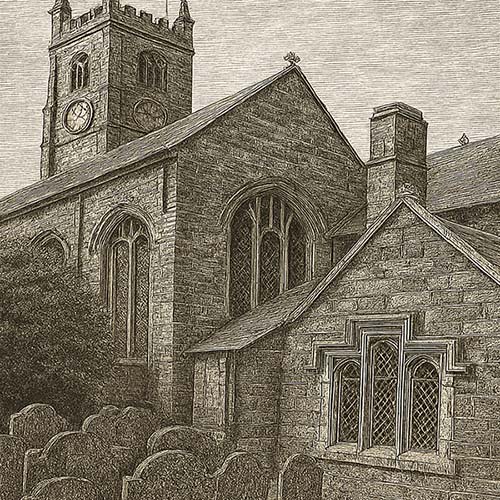
St. Eustachius Church in Tavistock is a real church that dates to approximately 1265.
Ship Names
Like people, ships frequently shared names. There are several references to the English Galley in royal inventories of the period, and some evidence suggests that the name referred to a ship not otherwise deemed important enough to catalog.
This is similar to the earlier use of the term “barque” or “bark,” which comes through French from the Latin word barca, meaning “boat,” and was applied to the ship on which Francis Drake was apprenticed.
The Tiger appears in the historical record. Her armament, modeled on that of the Cherabin, is my invention based on historical records of Hawkins’s ownership of a fleet of armed merchantmen. You can read more about the Cherabin in my post about Francis Drake’s ship .
The Tiger’s Trading Circuit
The Tiger’s year-long absence from Chatham is fictional but consistent with Tudor merchant practice. She is not continuously at sea. Instead, she works as an armed general trader in extended tramping employment, carrying successive cargoes between English and continental ports and sometimes taking a new cargo where the previous cargo was discharged. Ships in such employment could spend days or weeks waiting for merchants, customs clearance, cargo, wind, suitable tides, victuals, or ordinary repairs.
A Kent-based vessel could call at English ports other than her home port and combine coastwise and overseas voyages. The surviving evidence does not establish the Tiger’s exact 1553–1555 itinerary; systematic English coast port books begin in 1565. Contemporary and near-contemporary records nevertheless support the broader pattern of mixed routes, successive cargoes, remote port stays, and maintenance without a return to Chatham.
Explore the opening two chapters of Sic Parvis Magna , “Cold Winds” and “House of Hawkins.”
Read the opening scene of the historical fiction novel Sic Parvis Magna here: Going on Delivery .
Did You Like This?