Sic Parvis Magna—First Impressions of Plymouth (Chapter 2)
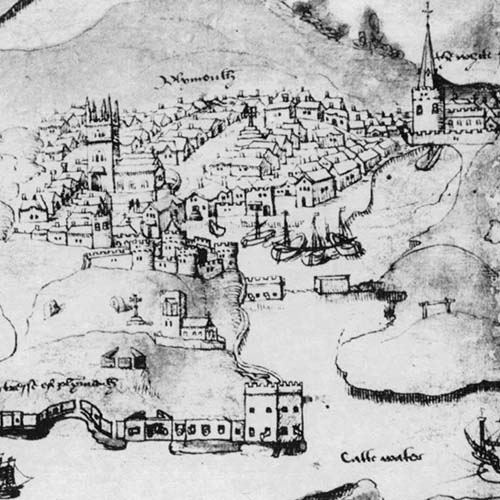

AFTER A DAY in the wagon, Francis woke to a noxious smell. He wrinkled his nose, then sat up and looked around.
The road passed through a midden towards a massive, dark slate gatehouse with a maw that swallowed the line of country folk taking their goods to the Plymouth market.
At the tail of the line, Grandfather climbed down and took the horse by the reins.
A farmer at the end turned, studying the newcomers. Remembering Edmund’s heretic explanation, Francis shrank back.
Mary stirred, opening her tired, bloodshot eyes. “Are you all right, Francis?”
Francis nodded.
“Father said that we were heretics,” he said under his breath. “But don’t we worship the same God—”
“No! We are of the true faith!” Mary caught herself, lowering her voice. She leaned forward to him. “The Romish Church serves the Antichrist himself.”
“Then what of the psalm Father teaches?” Francis pressed. “He that dwelleth in the secret place…”
“…shall abide under the shadow of the Almighty.” Mary completed the psalm.
Francis hesitated. “Where was His shadow last night?”
“The psalm speaks not of earthly safety, nor does He promise that we will be spared hardship.” She touched his cheek. “We fled, yes. But we are not abandoned. Suffering has its purpose.”
“What purpose did our suffering serve?” His voice was barely above a whisper.
Mary’s fingers lingered against his cheek as she searched for words.
Francis looked at her, waiting for more, but no answer came.
The echoing clop of the horse’s hooves against the stone returned Francis to the present.
Inside the gatehouse, two halberdiers clad in jack-of-plate armor stepped forward, tilting their halberds to stop the wagon. Francis’s eyes followed Grandfather as he approached an imposing sentry.
The man stood in a wide stance, his left hand resting on the hilt of his bollock dagger. A jagged finger-width scar ran from his temple to his upper lip. He greeted Grandfather with a disdainful, appraising look.
Lowering his head in a deferential nod, Grandfather reached inside his jerkin and produced a folded paper, which he offered to the guard.
The sentry unfolded and read the paper, examining the seal under the light of the nearby candle lantern.
“Step aside!” He waved off the halberdiers with a commanding gesture.
Francis breathed a sigh of relief as they exited the gatehouse onto the streets of Plymouth, taking in the tapestry of the unfamiliar city opening before him.
Never having ventured outside Tavistock, Francis was overwhelmed by the noise and chaotic intensity of this very foreign place.
Two- or three-story jettied houses crowded the street, some with a shopfront beneath a painted sign. Others were simpler, with a board laid out to display the goods that the merchants hawked.
He bit his lip.
There were people everywhere, and all of them seemed to be destitute, ragged, and dirty.
Tavistock was less… menacing.
They passed a merchant—an elderly woman in a dirty, oversized gray apron tending to the wares spread on a board before her. Narrowing her eyes, she turned her head, tracking the passing wagon like a predator. Francis averted his eyes, pressing against Mary.
A moment later, his attention darted to what seemed to be an alley between two houses, where a fight broke out between two men. Others joined, and Francis’s eyes stayed glued to the scene.
The wagon trundled through a few more turns and the din and stink of the marketplace faded. In what seemed to be a different part of town, they passed houses with large brick chimneys and glazed windows.
Coaches drawn by powerful black horses filled the street.
Francis watched as a footman rushed out of a house to open the coach’s door for a finely dressed man in an over-gown. He alighted and, without so much as a glance, walked into the house. Behind him, the footman handed the secretary box to a different servant who scurried after the man.
So consumed was Francis by his observations that he did not notice their wagon had stopped.
“Marjorie, my sister!” an unfamiliar voice boomed, startling Francis. “How very nice to see you and John again! And Edmund, and Mary! Welcome!”
Francis turned his head.
A tall, distinguished man stood in front of a stately house. He was dressed better than anyone Francis had ever seen, wearing an embroidered doublet over a white shirt, white knee-length breeches, and hose. Pearlescent square buckles adorned his shoes.
Next to him, dwarfed, stood Uncle John and a youth who looked like a younger, thinner, and more reserved copy of the man whose voice filled the street.
A solemn army of servants stood behind them.
Marjorie jumped off the wagon and ran up to the man with open arms.
“William, I see that time has been kind to you! And John Hawkins, we have not seen you in years! What a handsome young man you’ve grown into!”
Francis climbed down from the wagon and stood with an awkward smile, shifting from one leg to the other.
“Francis,” Mary said, leaning close, “that’s William Hawkins, your great-uncle. He’s a man of great importance here in Plymouth. And that is his son, John.”
Francis stole a glance at John. Standing in a wide stance with crossed arms, John Hawkins appeared to control the space around him rather than hide behind someone’s skirts.
John looked over towards Francis. Sensing Francis’s discomfort, he walked over, smiled, and extended his hand. “Hello, I am John Hawkins.”
“I… am very pleased to meet you, John.” Francis shook John’s hand.
“I’ll show you where you will stay,” said John.
They walked into the house as the servants began to offload the wagon and carry their belongings inside, streaming past Francis like a river around a rock.
As they walked through the great house, Francis felt as if he were in some exotic and faraway land. Their farmhouse had an earthen floor and whitewashed walls; here, Francis trod on polished oak. Dark panels lined the walls.
Biblical paintings competed for every inch of wall space with ship models and framed maps of places bearing labels Francis had never heard of before. Eyes from the portraits of stern-faced people followed Francis, making his skin prickle.
Suddenly, Francis stopped dead in his tracks.
He leaned in, examining every brushstroke of a large oil painting depicting two ships in a pitched battle.
Smoke billowed from cannons that protruded through the hulls like arrows from a quiver. One ship flew Saint George’s Cross, while the other flew a colorful ensign he had never seen before—a red rim dotted with little golden castles, and at its heart five blue shields in a cross pattern.
When he noticed Francis was no longer behind him, John returned.
“Father commissioned that painting after one of his battles. On the left is his William and John. The other ship, the Falcão, was so badly damaged that she caught on fire and sank during this battle,” he explained with a proud smile.
Lost in the scene, Francis took in the details—how the ships were positioned, the belch of fire and smoke, the chaos on deck. Somehow, for a brief while, the painting held him whole, his imagination carrying him far beyond yesterday.
Read the next scene from the historical fiction novel Sic Parvis Magna: “History of Hawkins” .
Did you miss the start? Read the opening scene, Going on Delivery or the overview of the opening two chapters .
Read my comments about who is real in Sic Parvis Magna .
Did You Like This?