Sic Parvis Magna—Family Dinner (Chapter 1)
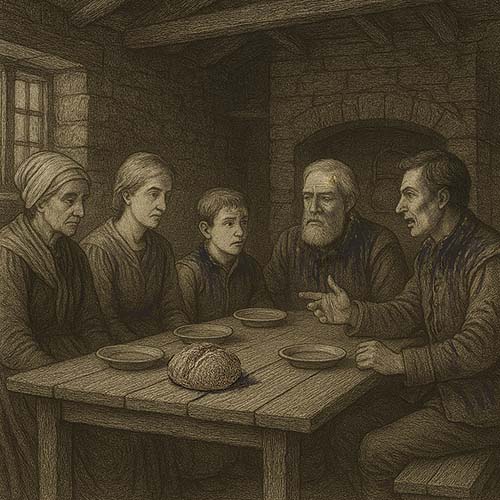

The adults’ conversation continued as Francis took his place at the table.
“‘Tis not the first time they have seen reforms,” said Marjorie.
Francis looked up at her, remembering the priest at the marketplace.
“Nothing changed after King Henry dissolved the monasteries twelve years ago,” she continued. “We agreed with Lord Russell to the same lease that we had held from the abbey.”
Francis dried his hands on his slops and drew the bowl closer.
Once Grandfather said grace, they could eat, and this terrible day would be behind him.
“Some folk weren’t as fortunate as we were,” said Uncle John. “I know good men who’ve lost their leaseholds and been turned out.”
Once she finished serving the food, Mary sat to apply salve to Edmund’s hands. Edmund, his father, was solemn and quiet. He flexed the fingers of his red and swollen hands, the pain evident on his face.
“Father, what happened to your hands?”
“Don’t mind that, Francis,” Mary said. “Eat your food.”
Francis waited, his hands folded.
No one joined him as he muttered the prayer.
He sank his wooden spoon into the bowl of piping-hot stew, using his bread to push pieces of meat and vegetables onto it.
“When I went to the market earlier today, I was ill at ease. I went out of my way to avoid some people. People are angry,” said Mary.
Francis blew on his stew, then took a careful spoonful, savoring the broth and chunks. He swallowed, allowing his gaze to go from person to person around the table. Whatever remained of his relief vanished.
Grandfather stirred his stew, his expression dark. “I heard they quartered a Helston man for the Body murder.”
The knot in Francis’s stomach tightened.
“That’s why the bells were ringing,” said John.
“By the rood, Edmund! How badly is Langiford hurt?” Grandfather demanded.
Francis’s next spoonful froze mid-air. He glanced at Grandfather, then at Edmund’s red hands.
“You shouldn’t have threatened him. He will run to the Justice of the Peace and say you robbed him.”
Edmund nodded. “The Lord knows I didn’t go there to quarrel. Langiford and Harte owe me a round sum for wages. We need the money to leave Tavistock, and I don’t have time to listen to his tales of how hard life was for him.”
Francis swallowed hard. It was not the first time his father had spoken of leaving.
“Lord Russell has not been in his lands for a long time, and there is no order in town. God only knows what’ll happen next.”
“They mean to tear down all the saints’ images in the churches,” said Francis in a small voice.
The conversation stopped and the crackle of the hearth fire was the only sound in the room. Everyone turned towards him.
“Where… have you heard that, son?” asked Mary.
Francis squirmed in his seat. He looked at his grandmother for assurance, took a deep breath, and described what he had seen at the marketplace and his conversation with the cook.
When he finished, he looked around him. Mary’s hands clasped the edge of the table, her knuckles white. Edmund’s jaw clenched, and John sat rigid, his eyes fixed on Francis.
Francis looked at Grandfather, whose brows were tightly pinched.
He crossed his arms. “Well, I hadn’t done nothing! I just delivered the eggs, like Grandmother asked!”
“Francis,” said Mary. “This is very important. What else did you see?”
“At the market—” He paused, fidgeting. “I saw a priest shouting at the crowd, but I did not hear what he said. The people shouted replies. I never saw that priest before—”
He trailed off as the adults exchanged worried looks.
“Mistress Smith, the cook—” He forced a more upbeat tone. “She sends you her compliments, Grandmother!”
Marjorie smiled. “Did she say anything else, Francis?”
“She said to take care!”
Marjorie’s smile faded.
“Tavistock won’t shelter us from this for much longer,” Grandfather said.
Francis lowered his eyes.
“Is there anything else?” asked Mary.
“I’m sorry, Mother. I thought it would be all right to stop at James’s house for a little.” Francis’s voice caught.
Mary placed her hand on his shoulder to encourage him.
“He refused to play with me.”
“Why?” asked Edmund.
“He called me a heretic and said that he would have nothing more to do with me. He threw rocks at me.”
Grandfather glanced at John, then at Edmund.
“Why did he do that?” asked Francis, picking at his food.
Mary rested her hand against the back of his neck.
“Father… why do we need to leave?”
The adults exchanged glances.
“We would feel safer away from Tavistock,” said Marjorie. “There are many here who—”
She trailed off.
“What’s a heretic?” asked Francis after a moment. His eyes stayed focused on a crumb he was rubbing between his fingers.
“Do you remember when I said that you can speak to God directly and that all that you need to guide you is in the Bible? That God has a plan for you?” asked Edmund.
Francis nodded.
“Well, those people in the marketplace believe that to talk to God, you must first talk to the priest in the church, and that to go to heaven, you must do certain things. They are afraid of our way. So, they call us names, throw rocks at us. To make us go away.”
Francis fought back his tears.
“Can’t I tell James I can talk to a priest, too?” He sobbed, then looked from one face to the next.
Mary’s gaze drifted off as she swiped a tear from her eye.
Grandfather looked at Edmund. “You’ll find no living reading prayers here.”
Edmund nodded.
Francis picked at his food for a little while longer and then quietly excused himself. He started for the cottage where he and his parents lived, leaving the sweet bread untouched.
However, no sooner had he taken ten paces down the path than he saw torchlights atop the ridge, a mile or two away.
Read the next scene from the historical fiction novel Sic Parvis Magna: “Escape from Tavistock” .
Did you miss the start? Read the opening scene, Going on Delivery or the overview of the opening two chapters .
Read my comments about who is real in Sic Parvis Magna .
About the Illustration
The engraving was created with an AI generator, prompted on the contents of this scene and modified.
Did You Like This?