Book Review: Historical Fiction Novel Eight Pointed Cross by Marthese Fenech
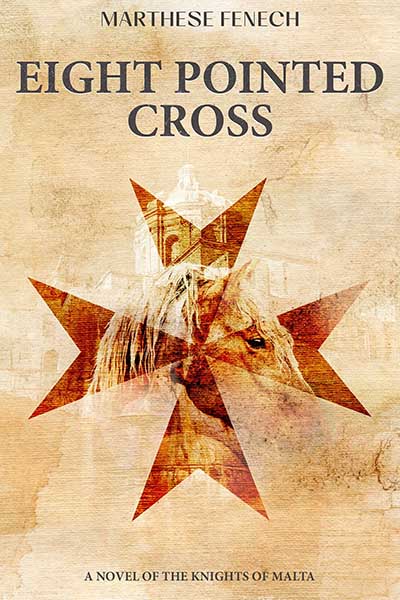

Eight Pointed Cross by Marthese Fenech is a historical fiction novel set primarily in sixteenth-century Malta, which is under mounting pressure from the conflict between the Knights of Saint John and the Ottoman world. The novel opens with the Montesa family—Augustine, a Maltese soldier in service to the Order, his wife Isabel, and their children Dom and Katrina—whose everyday life is shaped by corsair raids, poverty, and the deeply unequal structures of the society around them.
Running alongside is an Ottoman thread centered on Demir, a boy born into material comfort yet terrorized into someone else’s idea of conformity within his father’s household.
The characters are vivid, and I enjoyed following their complex struggle against the larger powers around them. I also liked that the novel refuses a simple heroes-versus-villains reading of history. This is voiced directly: “Heroes and villains are a matter of geography,” and that violence, moral compromise, and self-justifying power exist on both sides of the conflict.
Malta, given to the Knights by Charles V, is the Order’s fiefdom, and the Grand Master insists that the people’s “love matters not.” It, the Church, and the Università maintain their grip on power by crushing those that dare to oppose them, innocent or not. The worst offenders—even when the offense is simple jealousy—can disappear without process or trace.
In Yaminah’s household on the Turkish side, her son Demir is terrorized for amusement by his half-brother, by his father uses violence and cruelty to maintain discipline within his household that befits his view of himself.
At the same time, the novel does not flatten every individual within those systems into a villain. Individual decency matters, and Augustine’s, and Timurhan’s decency, Ruggieri’s moral compass, and the Sacra Infermeria’s care for rich and poor (though excluding women) keep the book from becoming simplistic.
Yaminah, abducted from Christian Malta, comes to see that what she was taught to believe about the “Ottoman barbarians”—including the corsair Dragut Raïs—does not properly account for the culture and people before her. Istanbul makes the Maltese towns seem backward, and unlike the class separation between the Knights and the Maltese, the man she was taught to vilify prays alongside the commoners.
Overall, the Eight Pointed Cross is a powerful historical fiction novel about power itself: who held it in 16th-century Malta and the Ottoman Empire, and who suffers beneath it. It is about how ideals—faith, order, honor, civilization—conceal self-interest. It insists that truth is complicated, that no side owns virtue, and that personal moral clarity, compassion, and courage matter. Yet, the book’s deeper achievement is that it does not leave the reader with cynicism.
I loved Eight Pointed Cross and recommend the book to historical fiction fans.
Get the Historical Fiction Novel Eight Pointed Cross by Marthese Fenech
Learn more about Marthese Fenech on her website.
I was given an ARC preview copy of the second edition of the historical fiction novel.
Did You Like This?
You might also be interested to read these: